A resource-loading scenario is a costed version of a proposed delivery team. It records roles, skill or location, allocation by period, duration, deal budget, and governed cost assumptions, then calculates an option margin on one consistent basis. Comparing scenarios reveals trade-offs; it does not automatically select the team most likely to deliver.
What belongs in a resource-loading scenario?
A scenario should express a delivery hypothesis in units that finance, presales, and delivery can inspect. At minimum, that means a named role or role profile, a time period, an allocation, a cost-rate basis, and the commercial amount against which cost will be compared. Skill, seniority, and delivery location may matter when they change capability or cost.
PMI's estimating guidance describes planned cost as a combination of the resources required, how long or how intensively they are applied, and their cost rates. That relationship makes a resource plan more useful than a single margin percentage: reviewers can see which assumption produced the result.
Option margin = deal budget − commission − labour cost − overhead
Use the firm's documented cost boundary. If overhead is already embedded in the cost rate, do not add the same cost again.
The scenario should remain a comparison model, not a staffing promise. A role may be a placeholder rather than a named person, and a financially attractive mix may still be unsuitable because of availability, skills, continuity, client commitments, or delivery risk.
Worked comparison: three ways to staff one deal
Assume a $120,000 fixed-price opportunity. Each option uses the same illustrative policy: 5% commission on the deal budget and overhead equal to 10% of labour cost. Labour has already been calculated from role allocations and governed cost rates.
| Option | Delivery idea | Labour | Commission | Overhead | Margin |
|---|---|---|---|---|---|
| A | Senior-heavy team | $60,000 | $6,000 | $6,000 | $48,000 / 40.0% |
| B | Balanced role mix | $50,000 | $6,000 | $5,000 | $59,000 / 49.2% |
| C | Lean junior-heavy mix | $45,000 | $6,000 | $4,500 | $64,500 / 53.8% |
Option C has the highest calculated margin, but the table does not prove it is the best delivery choice. The review must ask whether the team can perform the scope at the planned allocation, whether senior oversight is sufficient, whether work can be delegated, and whether the required people are realistically available.
Option B may be selected if it provides a more credible delivery shape while meeting the firm's commercial threshold. Option A might be justified for a high-complexity engagement or a client requirement. The purpose of a scenario comparison is to make that decision traceable, not to reduce it to one number.
A practical scenario-review checklist
- Hold the commercial basis constant. Compare options against the same deal budget, scope version, commission rule, and overhead rule.
- Check the time shape. Confirm that allocation by period matches the actual sequence of work, including mobilisation and closeout.
- Challenge role feasibility. Ask whether each role has the required skill and whether the planned work can be performed at that seniority.
- Trace every rate. Record the effective cost assumption and flag project-specific overrides.
- Test sensitive inputs. Examine how a longer duration, higher allocation, or changed role mix affects cost and margin.
- Document the selection. Record why the chosen option is commercially acceptable and operationally credible.
The UK Infrastructure and Projects Authority's cost-estimating guidance recommends documenting assumptions and exclusions, using consistent units and baselines, reviewing evidence, and applying sensitivity analysis. A lightweight services-pricing review can use the same disciplines without pretending the comparison predicts an outcome.
How does this comparison play out on a data-migration project?
Consider a systems integrator pricing a fixed-price data-migration project: extracting, cleansing, and loading a client's legacy records into a new platform over four months.
At the proposal stage, presales builds three resource-loading options using the same method as the worked comparison above: a senior-heavy option with two data architects, a balanced option adding a data analyst, and a lean option leaning on junior analysts for the bulk of transformation work. Each option holds the deal budget, commission rule, and overhead rule constant, exactly as the review checklist above requires.
Mid-build, the cleansing phase reveals more inconsistent source records than expected. If the lean option was selected, this is where the shortfall in senior oversight shows up first — a junior-heavy team can move fast on clean records but struggles with judgment calls on ambiguous ones. That is the checklist's "challenge role feasibility" step playing out in practice, not a hypothetical.
At the pre-cutover review, the client requests an additional legacy source system be included. That is a scope change against the option's original deal budget and role mix, not a reason to silently add hours to the existing plan — hold the commercial basis constant per the checklist and price the addition as its own resourcing decision, using the cost-estimation method for the added scope.
At cutover, if the originally scoped data architect is reassigned to another engagement, the team substitutes a different architect at a different cost rate. Because the promoted baseline used a role-based placeholder rather than a named person, the substitution itself does not break the plan, but the team still needs to re-check whether the new cost rate changes the calculated margin the option was chosen on.
At project close, compare which option's assumptions actually held: did the senior-heavy or balanced option's role mix match what cleansing and migration actually needed? Feed that back into how the next data-migration proposal gets staffed, rather than treating each comparison as a one-off exercise.
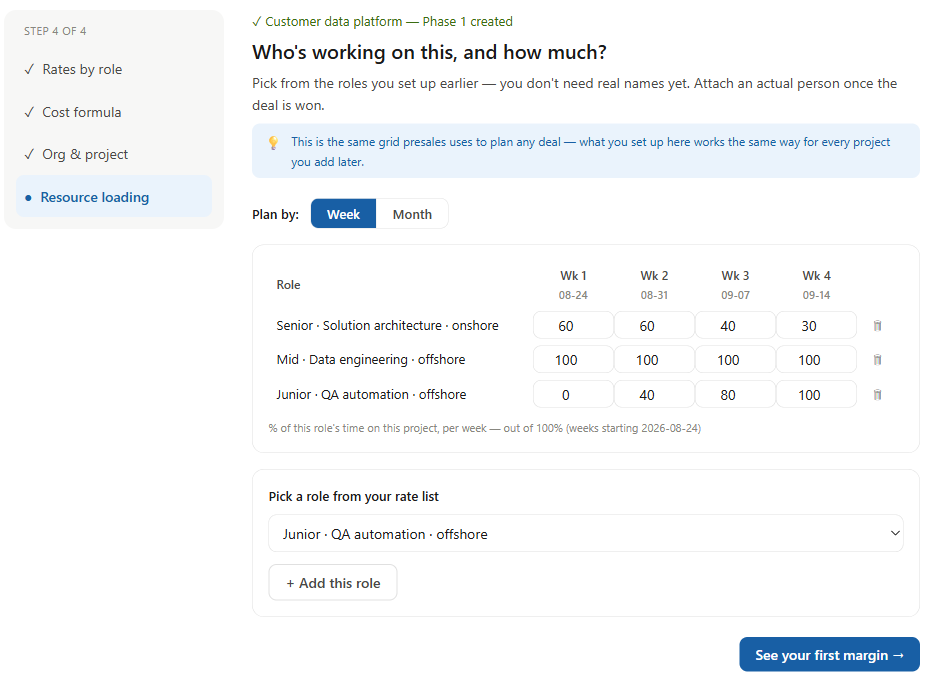
What does a Managed Margin scenario calculate?
In Managed Margin, authorised users can build monthly resource-loading scenarios across a six-month grid. The current preview calculates pay-rate-derived labour from the selected role variants and allocations. It then uses the deal budget, configured commission, and configured overhead to show scenario margin. Billing rates are not used in this preview.
The calculation is only as current as its inputs. It does not confirm named-resource availability, forecast final project margin, or guarantee that the team can deliver the scope. Managed Margin does not import CRM, HR, payroll, timesheet, ERP, accounting, or invoicing data.
Promotion is available for fixed-price projects only. It creates the approved budget and placeholder allocations from the selected option, but it does not activate delivery. The team must still assign named resources and complete the delivery plan. Read the pricing-option handoff guide, or see the presales pricing workflow.
Sources and methodology
- Project Management Institute, Project Management 101: Estimating. Used for the relationship among resources, duration or application, rates, and planned cost.
- UK Infrastructure and Projects Authority, Cost Estimating Guidance. Used for assumptions, evidence, consistent baselines, review, and sensitivity principles.
- The worked comparison is original. Product claims were checked against the Managed Margin implementation on 24 August 2026.