A pricing option becomes a delivery baseline when the selected budget, role plan, planned effort, cost assumptions, and scope version are approved and preserved for later comparison. The handoff is incomplete until placeholders are staffed and delivery timing is confirmed. Approval should identify changes explicitly rather than overwrite the original assumptions.
What must cross the presales-to-delivery boundary?
A price can be commercially approved while the delivery plan remains ambiguous. The baseline closes that gap by preserving the assumptions against which current performance will be compared. PMI's 2026 lexicon defines a baseline as an approved version of a work product that can be changed only through formal change-control procedures and is used for comparison. A services firm can apply that principle proportionately, even when its operating process is lightweight.
| Handoff field | What delivery needs to know | Why it matters |
|---|---|---|
| Scope reference | Approved proposal or statement-of-work version, assumptions, exclusions | Connects effort to the work that was priced |
| Commercial basis | Fixed-price budget, currency, commission treatment, included costs | Defines the margin calculation boundary |
| Selected option | Which scenario was approved and why | Prevents a rejected option becoming the working plan |
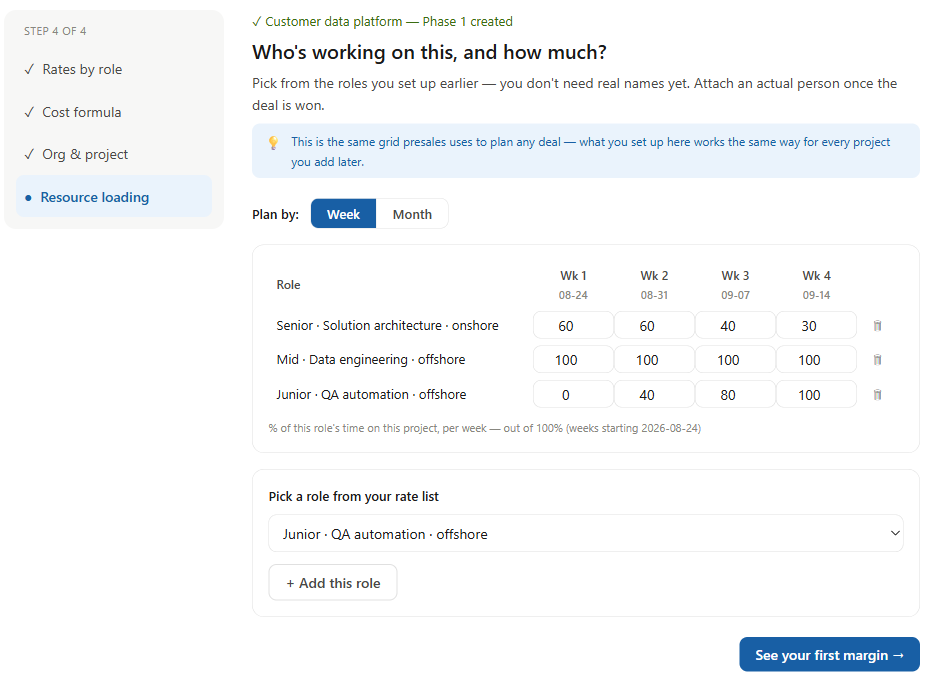
| Role plan | Role, skill or location, period, allocation, and planned effort | Makes labour assumptions operational |
| Rate basis | Cost-rate entries and effective dates used for approval | Preserves estimate traceability |
| Staffing status | Placeholders, named resources, gaps, and owner | Separates an approved shape from a staffed plan |
| Approval record | Decision owner, date, and accepted exceptions | Makes later variance discussions factual |
The baseline is not a prediction that every week will follow the plan exactly. It is the approved reference. Changes should be recorded in a way that distinguishes a revised decision from an execution variance; otherwise the organisation loses the ability to explain what changed and why.
This handoff is really an estimate-maturity jump: a number that was precise enough to win the deal is not automatically precise enough to run delivery against. See ROM versus definitive estimate for how that distinction is defined upstream, before pricing ever reaches this handoff.
Worked handoff: a fixed-price implementation
Suppose presales compares three options for a $90,000 fixed-price engagement and selects Option B. Its plan contains a lead, consultant, and analyst distributed over three months. Option B was selected because its role mix was considered deliverable and its calculated margin met the firm's internal threshold.
The handoff can follow four controlled steps:
- Approve the commercial record. Preserve the $90,000 budget, scope version, selected option, cost assumptions, commission, overhead, owner, and approval date.
- Create the delivery starting point. Transfer the selected roles and allocations as placeholders rather than implying that named people are already committed.
- Complete staffing and timing. Delivery assigns available people, converts the monthly commercial shape into its weekly operating plan, and resolves skill or capacity gaps.
- Confirm readiness. An authorised owner checks that budget, plan, and assignments are complete before activating delivery tracking.
If the assigned consultant has a different current cost rate from the role assumption, the team should show that difference rather than silently changing the approved scenario. If the client also changes scope, record the commercial decision separately. This preserves the difference between estimate quality, staffing change, and scope change.
Could a delivery manager explain the approved budget, planned role mix, cost basis, known gaps, and activation decision without reopening the original pricing spreadsheet?
Baseline-approval checklist
- The fixed-price budget and currency match the approved commercial document.
- The selected pricing option is identifiable; rejected options remain reference material.
- Scope assumptions and exclusions have a version or dated source.
- Role, skill or location, duration, and allocation are explicit.
- Cost rates and effective dates are traceable to a governed rate card.
- Commission, overhead, and other included costs use documented definitions.
- Placeholders and named assignments are clearly distinguished.
- Known staffing or timing gaps have an owner.
- The approval owner and date are recorded.
- Later changes will be recorded instead of overwriting the starting point.
The UK cost-estimating guidance recommends consistent baselines, documented assumptions and exclusions, review, assurance, and comparison of estimates with actuals. PMI's fixed-price project case study similarly emphasizes defined scope, a project baseline, progress assessment, and captured actual cost. These sources support the control model; they do not establish a universal workflow for every consultancy.
How this shows up on a fixed-price infrastructure rollout
Suppose a network-services consultancy sells a fixed-price rollout of new switches, wireless, and cloud connectivity across twelve client sites, staffed with a project lead and a pool of field engineers. The handoff and every stage after it can go wrong in specific, predictable ways.
- At the presales-to-delivery handoff. Delivery is given the total budget and site count but not the underlying role plan, rate basis, or scope version behind it. Use the handoff-field table above as a literal checklist at this step, not just the headline price.
- At staffing. Placeholder engineer allocations must become named people before activation. If the engineer actually assigned has a different cost rate than the role assumption used to win the deal, show that difference explicitly rather than quietly absorbing it into the plan.
- When the client adds three more sites mid-rollout. Treat the extra sites as a separate, approved commercial decision with their own budget and effective date—never merge them into the original twelve-site baseline, or later reviews cannot tell which sites were over or under plan.
- When equipment shipments run late. Field engineers idle on site, or travel back a second time, while waiting on hardware. That drives up labour cost without any staffing decision or scope change behind it. Keep this distinct from a rate or role-mix problem; see how to trace project margin variance to its actual driver rather than a single "delivery issue" label.
- At rollout close. Confirm the final actuals reconcile against the original baseline plus every approved change, and that any staffing or equipment gap that was still open at an earlier review has a named owner and a resolution, not just a note that it existed.
What happens when Managed Margin promotes an option?
Managed Margin supports promotion for fixed-price scenarios only. Promotion writes the approved project budget and creates placeholder allocations from the selected option. It does not activate delivery, commit named people, validate their availability, or forecast the final margin.
Delivery must assign named resources, complete the weekly plan, and use the authorised activation step. Once work is active, users with the required access can record weekly actual hours and review current planned-versus-actual results. The product does not import timesheets or data from CRM, HR, payroll, accounting, invoicing, or ERP systems.
Start with the professional-services project pricing guide and its resource-loading scenarios, then see how to track delivery margin after the baseline is ready.
Sources and methodology
- Project Management Institute, PMI Lexicon of Project Management Terms, version 5, 2026. Used for the definition and purpose of a baseline.
- UK Infrastructure and Projects Authority, Cost Estimating Guidance. Used for assumptions, exclusions, consistent baselines, review, and estimate-to-actual comparison.
- Project Management Institute, Managing fixed-price projects using earned value management. Used for scope, baseline, progress, and actual-cost principles, not as a claim that Managed Margin implements formal EVM.
- The handoff example is original. Product claims were checked against the Managed Margin implementation on 24 August 2026.