To calculate project margin, subtract the delivery costs included by your firm from the project's approved revenue basis. Divide that difference by the same revenue basis and multiply by 100. Document the cost boundary first, and compare planned with actual figures only for a consistent basis and cut-off. A current margin is an observation, not a final forecast.
What is the project-margin formula?
Project margin = approved project revenue basis - included delivery costs
Project margin % = project margin / approved project revenue basis x 100
The arithmetic is straightforward. The useful work is defining each input. "Project revenue basis" might be an approved fixed fee for an internal management view. "Included delivery costs" might include labour, employment overhead, subcontractors, infrastructure, travel, commission, or other project costs. If the definition changes between reports, the percentages are not directly comparable.
Keep this internal project-control calculation separate from statutory revenue recognition. IFRS 15 requires entities applying IFRS to recognise contract revenue according to performance obligations and transfer of promised goods or services. A management dashboard using an approved fee does not replace that accounting policy.
Which revenue and costs should be included?
Finance should approve one written basis for the use case. The UK Infrastructure and Projects Authority advises cost estimators to document methodology, assumptions, exclusions, evidence, and ownership. That guidance is aimed at major projects, but the control principle is useful for services work: readers must know what the number contains.
| Input | Question to answer | Example policy |
|---|---|---|
| Revenue basis | Which approved amount is the denominator? | Signed fixed fee, excluding taxes collected for authorities. |
| Labour | Which cost rate and hours are used? | Internal pay-cost rate multiplied by planned or recorded hours. |
| Labour overhead | Are employment on-costs included? | A governed percentage of labour cost. |
| Other direct cost | Which non-labour items belong to the project? | Subcontractor, infrastructure, travel, or visa cost when applicable. |
| Commercial cost | Is commission inside the project view? | A stated percentage of the approved fee. |
| Shared cost | Is this shown inside gross margin or as a separate layer? | Keep it separate so direct project economics remain visible. |
Worked example for a fixed-price services project
Assume an approved fixed fee of USD 100,000. The firm's internal project-margin policy includes commission, pay-rate labour, labour overhead, and infrastructure. The figures are synthetic and are not a benchmark.
| Component | Calculation | Amount |
|---|---|---|
| Approved fee | Revenue basis | USD 100,000 |
| Sales commission | 5% x USD 100,000 | USD 5,000 |
| Planned labour | Role hours x governed pay-cost rates | USD 42,000 |
| Labour overhead | 15% x USD 42,000 | USD 6,300 |
| Infrastructure | Included project items | USD 4,000 |
| Included costs | 5,000 + 42,000 + 6,300 + 4,000 | USD 57,300 |
Project margin = USD 100,000 - USD 57,300 = USD 42,700
Project margin % = USD 42,700 / USD 100,000 x 100 = 42.70%
The 42.70% result describes this stated cost basis. If a USD 7,000 share of central delivery-management cost is allocated separately, the amount after that shared cost is USD 35,700, or 35.70%. Managed Margin calls that second product-specific layer Managed Margin; it is not operating or net margin.
The USD 5,000 commission line above is also a common source of confusion between teams. A salesperson quoting the deal may only see the gross spread between the fee and delivery cost before commission and overhead are removed; finance sees the fully-loaded figure. See gross contribution versus net margin for sales for why those two views can legitimately disagree without either being wrong.
How should planned and actual margin be compared?
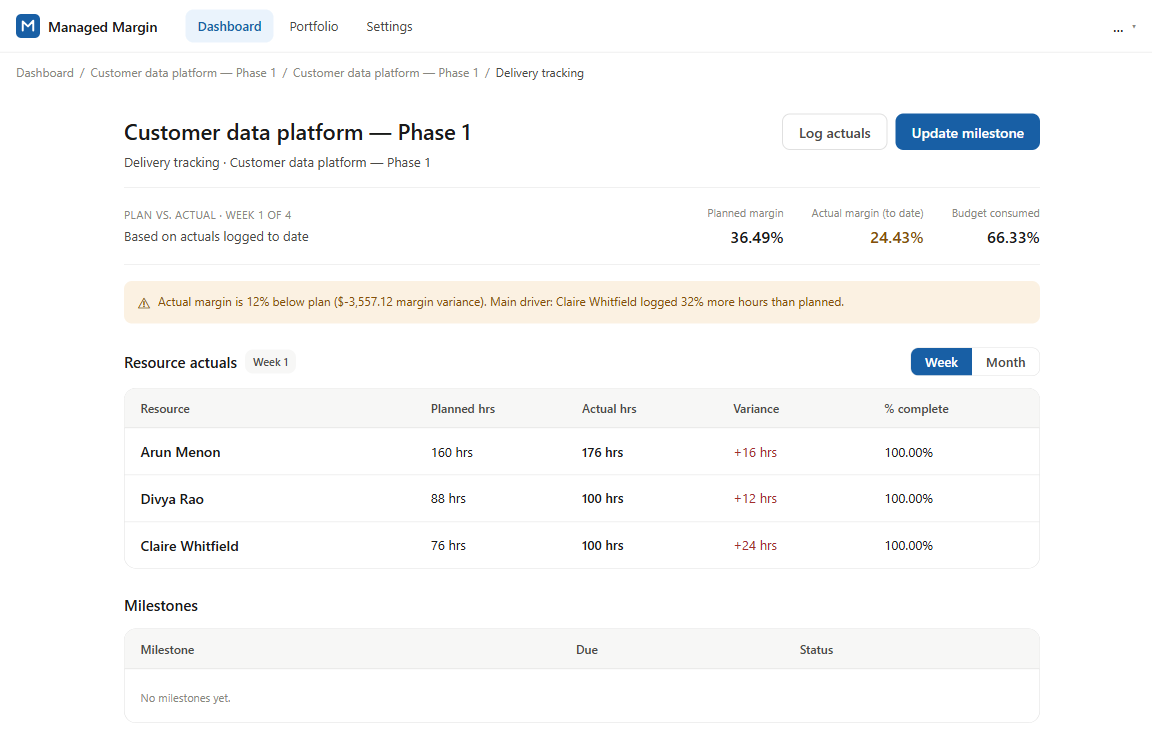
Use the approved baseline for the planned side and complete, period-appropriate entries for the actual side. Compare role-level hours before looking at the overall percentage. Twelve extra hours can have a small total-hours effect but a larger cost effect if the work moved to a more expensive role.
Managed Margin records actual hours by resource and week and costs each saved week at the applicable stored rate. It recalculates an actual-to-date view after authorised users save supported entries. Because the approved budget remains the revenue basis while unrecorded future effort is unknown, an early actual-to-date percentage can look high. Read it beside completion context, budget consumption, and remaining scope. It is not a predictive end-of-project margin.
Project-margin calculation checklist
- Name the approved revenue basis and its effective date.
- List every included and excluded cost category.
- Confirm that hours, rates, currency, and time periods are consistent.
- Calculate the dollar margin before the percentage.
- Reconcile the result to its source inputs.
- For actuals, confirm that entries are complete through the stated cut-off.
- Explain material changes in role mix, rates, scope, or non-labour cost.
- Label shared-cost, gross-margin, and accounting views separately.
How does the calculation hold up across a multi-wave data-migration project?
The formula above is easy to apply to one clean number. It gets harder to apply consistently once a single engagement is delivered in stages, which is exactly what happens on a legacy-to-cloud data-migration project priced as one fixed fee but executed as three sequential waves — HR data, financial data, then customer data — each with its own client sign-off.
- At kickoff, the team must decide how the one approved revenue basis relates to three waves invoiced at different times. Splitting the fee into three separate "wave margins" that do not reconcile back to the whole contract is a common mistake. Handling: per the basis checklist above, name the approved revenue basis once, for the full contract, and track wave-level cost against that single basis rather than inventing three unrelated denominators.
- Mid-wave, a data-quality problem in the source financial system forces cleansing hours that were never in the original estimate. The team is tempted to quietly absorb the extra cost into wave 2's own mini-calculation. Handling: keep the approved baseline untouched and record the additional hours as actual cost against it, the same way a margin variance is reported elsewhere — a visible drop in the percentage is more useful than a smoothed-over one.
- At each milestone invoice, the client pays for a completed wave, and it becomes tempting to calculate margin on cash invoiced-to-date rather than the full approved fee. Handling: keep this internal control number tied to the full revenue basis, exactly as the earlier accounting-boundary note describes — invoicing schedule and revenue recognition are separate questions from the project-control percentage.
- At project close, a shared cost such as a migration-tooling licence purchased once but used across all three waves must be assigned rather than dropped into whichever wave closes last. Handling: apply the same shared-cost decision from the revenue-and-cost table above — decide up front whether it sits inside gross margin or in a separate allocated layer, and apply that choice to every wave, not just the final one.
None of these situations changes the formula. They change how disciplined the team must be about applying one fixed basis and one cost policy across time, which is precisely what a documented basis is for.
What does project margin not tell you?
Project margin does not by itself measure delivery quality, cash collection, revenue-recognition compliance, schedule feasibility, client satisfaction, workforce capacity, operating margin, or net margin. It also cannot predict costs that have not been estimated or recorded. A well-calculated percentage supports a decision; it does not make the decision.
For a complete operating workflow, read the project margin management guide and the planned-versus-actual review checklist.
Sources and methodology
- IFRS Foundation, IFRS 15 Revenue from Contracts with Customers. Used to distinguish an internal project-control revenue basis from statutory revenue recognition.
- UK Infrastructure and Projects Authority, Cost Estimating Guidance. Used for assumptions, exclusions, evidence, ownership, and consistent-baseline principles.
- The Managed Margin formula boundaries and weekly-rate treatment were reviewed against the current implementation on 24 August 2026. All figures are illustrative.