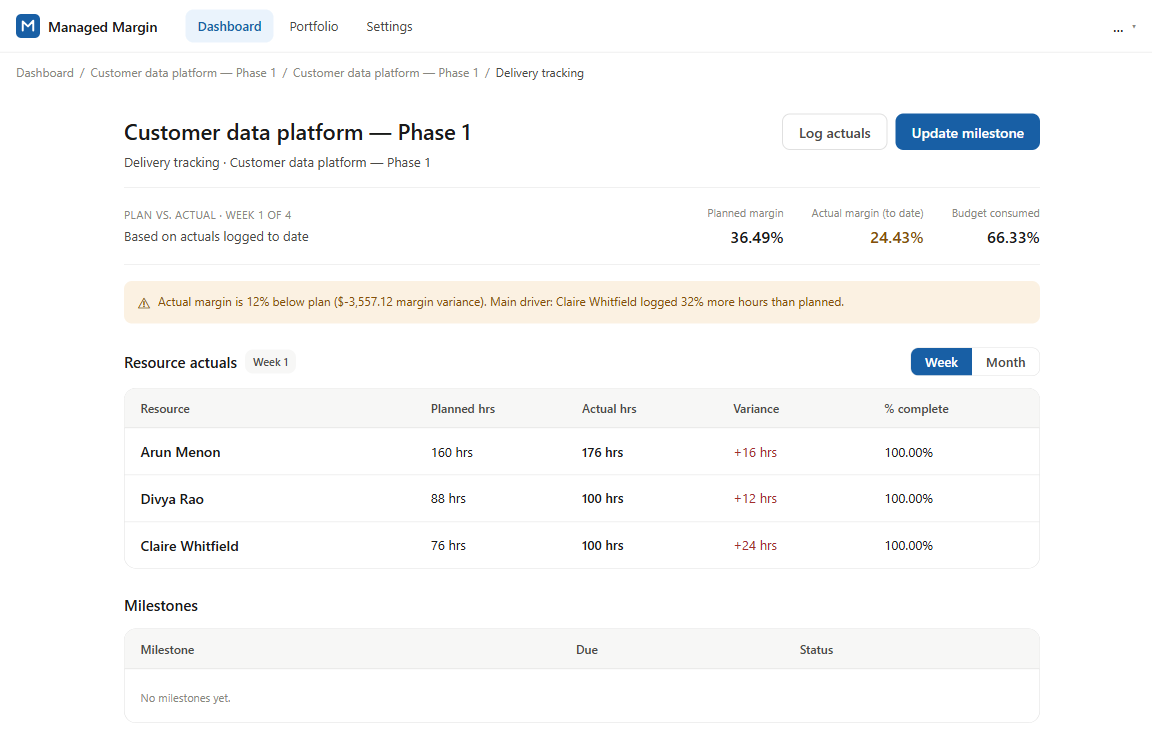
Project budget consumption — sometimes called burn rate — shows how much of a defined delivery-cost budget has been used by recorded costs. In Managed Margin, budget used equals actual labour plus recorded partner and infrastructure costs, divided by the deliverable budget. It is a current cost-consumption measure, not percentage complete, workforce utilisation, project profit, or a prediction of the final cost.
How does Managed Margin calculate budget used?
Deliverable budget = approved budget - sales commission
Recorded actual cost = actual labour + recorded partner cost + recorded infrastructure cost
Budget consumption % = recorded actual cost / deliverable budget x 100
The numerator is deliberately narrower than every cost appearing in the full margin calculation. In the current product, it includes actual labour cost plus supported partner and infrastructure actuals. It excludes calculated labour overhead, project-overhead percentage, visa cost, shared costs, and custom calculated components from the budget-used numerator. That boundary should remain visible whenever the percentage is discussed.
Actual labour comes from saved weekly hours costed at the applicable stored rate. The application does not import employee timesheets, payroll, HR, accounting, or CRM data. The metric is only as current as the entries supplied by authorised project users.
Worked example: what does 41.05% consumed mean?
Assume a USD 100,000 approved fixed fee and a 5% commission. The deliverable budget is USD 95,000. Through the review cut-off, the project has USD 31,000 of actual labour, USD 6,000 of recorded partner cost, and USD 2,000 of recorded infrastructure cost.
| Input | Calculation | Amount |
|---|---|---|
| Approved budget | Fixed-fee basis | USD 100,000 |
| Commission | 5% x USD 100,000 | USD 5,000 |
| Deliverable budget | 100,000 - 5,000 | USD 95,000 |
| Actual labour | Recorded hours x applicable rates | USD 31,000 |
| Partner actual | Recorded cost | USD 6,000 |
| Infrastructure actual | Recorded cost | USD 2,000 |
| Recorded actual cost | 31,000 + 6,000 + 2,000 | USD 39,000 |
Budget consumption = USD 39,000 / USD 95,000 x 100 = 41.05%
The result says that the recorded cost categories equal 41.05% of the defined deliverable budget. It does not say that 41.05% of the scope is complete. If delivery is only 25% complete, the difference deserves investigation. If delivery is 55% complete, the relationship may look favourable, but missing actuals or future high-cost work could still change the picture.
What does consumption above 100% mean?
Consumption is not capped at 100%. Continuing the same project, suppose recorded actual cost later reaches USD 75,000 of actual labour, USD 15,000 of partner cost, and USD 9,750 of infrastructure against the same USD 95,000 deliverable budget.
Recorded actual cost = USD 75,000 + USD 15,000 + USD 9,750 = USD 99,750
Budget consumption = USD 99,750 / USD 95,000 x 100 = 105%
The deliverable budget has now been fully used and exceeded, regardless of how much scope is actually complete. This is a materially different state from the 41.05% example above: every alert stage described below should already have fired well before this point, and a review at this stage needs to explain why it did not, not just confirm the current percentage.
Which metrics should be read beside budget consumption?
A baseline makes cost and progress comparisons meaningful. PMI describes a performance baseline as the reference needed to compare planned work, accomplished work, and actual cost. Managed Margin does not implement formal earned-value forecasting, but the underlying discipline still applies: use a consistent plan and do not confuse money spent with work completed.
| Metric | Question it answers | What it does not answer |
|---|---|---|
| Budget consumption | How much of the defined cost budget is represented by recorded cost? | How much scope is complete? |
| Completion context | How much agreed work has been completed or accepted? | What did that work cost? |
| Hours variance | Are recorded hours following the resource plan? | Did the role mix increase cost? |
| Project margin | What remains after the stated cost basis? | Will the project finish at that margin? |
| Remaining scope | What work and dependencies are still open? | What will that work cost without an estimate? |
How should budget-consumption alerts be interpreted?
The current Managed Margin implementation checks supported alert stages at 50%, 80%, and 95% of budget consumption. Its highest stage can also trigger when the gross-margin status is red. These thresholds are product workflow signals, not universal benchmarks or proof that a project is healthy or unhealthy.
An alert should start a review: confirm actuals, inspect the expensive resources or cost items, compare progress, and record the action owner. It should not automatically produce a staffing, scope, or client decision. The current alert creation is first-crossing-only for each stage; the read side recalculates whether a stored alert remains crossed.
How budget consumption plays out on a data-migration project
Consider a firm delivering a fixed-price migration of a client's on-premises data warehouse to a cloud platform, covering discovery, cleansing, staged migration waves, validation, and cutover. Budget consumption reads differently at each stage.
- At kickoff. The deliverable budget is only as good as the labour estimate behind it. Build that estimate from the roles, effort, and rates actually needed for cleansing and migration work—see resource-based project cost estimation—rather than a single round-number allowance.
- Mid-migration, when source data is messier than expected. Data engineers spend extra hours on cleansing rework that was not scoped. Budget consumption climbs faster than completion, which is exactly the signal to investigate, not a verdict on its own—read it beside completion context and hours variance as described above.
- When the client adds a source system mid-project. Treat that as an approved budget change, not a reason to keep watching the same deliverable-budget denominator. An unchanged denominator against expanded scope makes the consumption percentage meaningless.
- At the 80% consumption alert. Migration projects typically back-load risk into validation and cutover, the most cost-intensive stage. Do not read 80% consumed as "nearly done"; use the alert to start a review of remaining cutover effort against remaining budget, not to assume the project is on track.
- At cutover and close. Reconcile final recorded cost against the deliverable budget and confirmed completion before calling the migration finished, and record any excluded cost categories that were tracked separately outside this percentage.
Budget-consumption review checklist
- State the data cut-off and confirm all weekly actuals through that date.
- Reconcile partner and infrastructure actuals to their source records.
- Confirm the approved budget and commission used to form deliverable budget.
- Compare planned and actual hours by resource for the same period.
- Read cost consumption beside completion and remaining scope.
- Identify cost categories that are excluded from this percentage.
- Explain material role-mix, rate, scope, or timing differences.
- Record the decision, owner, and next review date.
Use the planned-versus-actual project margin review for the meeting sequence. The professional-services project margin guide provides the broader workflow; for the formula, see how to calculate project margin.
Sources and methodology
- Project Management Institute, Taking step four with earned value: establish the project baseline. Used for the baseline, planned-work, accomplished-work, and actual-cost distinction. Managed Margin does not claim formal earned-value forecasting.
- U.S. Government Accountability Office, Cost Estimating and Assessment Guide. Used for maintaining a technical baseline, documented assumptions, and updating estimates with actual costs.
- The budget-used numerator, denominator, alert thresholds, actual-entry workflow, and limitations were reviewed against the current Managed Margin implementation on 24 August 2026. Figures are illustrative.