Project pricing for professional services converts a defined scope and proposed delivery team into a commercial price. A useful model estimates resource effort by role and period, applies documented cost assumptions, includes relevant non-labour costs, and tests the resulting margin. The selected option should remain traceable when delivery begins.
What is different about pricing professional-services projects?
People are usually the largest controllable delivery input. The work is therefore priced more reliably when the estimate explains who is needed, at what level, for how much time, and over which period. A price built only from a target percentage can hide an unrealistic team plan. A staffing plan built without a commercial calculation can be deliverable but uneconomic.
Project cost and project price are related, but they are not the same. Cost is the firm's estimate of the resources and other inputs required to deliver the work. Price is the commercial amount proposed to the client. Margin is the difference between the agreed revenue basis and the costs included in the firm's policy. Sales teams sometimes treat an early, direct-cost-only figure as "the margin" before commission and overhead are subtracted; see gross contribution versus net margin for sales teams for why that distinction matters before a number reaches an approval conversation.
Planned resource hours × approved cost rate = planned labour cost
Deal budget − included delivery costs = calculated scenario margin
Calculated scenario margin ÷ deal budget × 100 = scenario margin %
The UK Infrastructure and Projects Authority recommends that cost estimates document their methodology, assumptions, exclusions, evidence, and uncertainty. Its guidance is written for public infrastructure rather than consulting proposals, but the underlying control is transferable: a decision maker should be able to understand how an estimate was built and what could change it.
Which inputs should a project-pricing model preserve?
The smallest useful model is not necessarily the one with the fewest rows. It is the one that retains enough detail to explain a decision without creating false precision.
| Input | Question it answers | Control to document |
|---|---|---|
| Scope and deliverables | What work is included in the price? | Exclusions, acceptance boundary, and change process. |
| Role and skill mix | What kind of team is required? | Role definitions, skill tags, and delivery reviewer. |
| Location | Which cost and working assumptions apply? | Named location categories and approved rate source. |
| Allocation and duration | How much effort is planned and when? | Percentage or hours, period length, and standard hours basis. |
| Cost rate | What does the planned labour consume? | Rate owner, effective date, and included cost elements. |
| Commercial components | What else reduces the amount available for delivery and margin? | Commission, overhead, direct costs, and exclusions. |
| Deal budget | What revenue basis is being tested? | Currency, pricing model, scope version, and approval status. |
For a deeper calculation method, see resource-based project cost estimation. For rate governance, use the project rate-card guide.
Worked example: price a proposed consulting team
Assume a fixed-price engagement has an $80,000 proposed deal budget. The presales team models three roles using the firm's approved hourly cost inputs. This is an educational example, not a benchmark or customer result.
| Role | Planned hours | Cost rate | Planned labour cost |
|---|---|---|---|
| Senior consultant | 160 | $80 | $12,800 |
| Consultant | 320 | $50 | $16,000 |
| Analyst | 240 | $30 | $7,200 |
| Total | 720 | — | $36,000 |
If the firm's scenario policy applies 4% sales commission to the $80,000 deal budget and 10% overhead to labour cost, commission is $3,200 and overhead is $3,600. The calculated scenario margin is $37,200, or 46.5% of the deal budget.
$80,000 − $3,200 − $36,000 − $3,600 = $37,200
$37,200 ÷ $80,000 × 100 = 46.5%
That percentage does not prove the team can deliver the scope. Delivery still needs to validate the role mix, effort, and timing. It is also not a forecast of the final result; it is a transparent result from entered assumptions.
Why compare resource-loading scenarios?
A single scenario invites a yes-or-no reaction. Multiple scenarios make the trade-offs visible. One option may use more senior time and cost more. Another may use a leverage-heavy team but require stronger review. The goal is not automatically to select the highest calculated margin. The goal is to select a plan that is commercially acceptable and operationally credible.
Review each option on the same basis
- Keep the scope and deal-budget definition consistent unless the purpose is to test a scope or price change.
- Use governed cost rates with clear effective dates.
- State commission, overhead, and other included costs rather than hiding them in a percentage.
- Ask delivery to challenge role mix, allocation, timing, and handoffs.
- Retain rejected options for context instead of overwriting the only workbook.
The resource-loading scenario guide includes a three-option comparison and decision checklist.
Give each review question an owner
Pricing works better when approval is shared but accountability is specific.
| Role | Reviews | Can override |
|---|---|---|
| Sales or presales | Client-facing scope, price, and commission assumption | Scope wording and the quoted price |
| Delivery | Role mix, effort, timing, and handoffs | Staffing plan and delivery approach |
| Finance | Rate basis, overhead treatment, currency, and calculation boundary | Cost policy and calculation assumptions |
| Final approver | Which option was selected and which exceptions were accepted | Whether the option proceeds to delivery |
This division prevents a common failure: a commercially attractive spreadsheet passes approval even though nobody has accepted responsibility for delivery feasibility. It also makes later review more useful. A rate exception is different from missing scope; a staffing substitution is different from a price concession. Recording the decision owner and reason lets the team respond to the actual cause rather than debate which version of the proposal was intended.
How does a staff-augmentation engagement move through pricing review?
The worked example above prices a fixed-price team. Staff-augmentation work follows the same resource-based sequence but is priced and re-priced more often, since the client can change headcount during the engagement. Consider an illustrative case: a mid-size systems integrator proposes three onshore roles to a client on a monthly staff-augmentation basis, then the client asks to scale the team and extend the term. This scenario is illustrative, not an industry benchmark.
- At kickoff: sales proposes an offshore-heavy role mix to hit a target margin before delivery has confirmed the roles are realistic for the client's environment. Use the review-ownership table above so delivery signs off on role mix and timing before the price is quoted, not after.
- During commercial negotiation: the client asks for a lower billing rate in exchange for a longer minimum term. Treat this as a governed rate exception rather than a quiet discount; the project rate-card guide covers how to record an exception without changing the standard card.
- At a scope change: the client scales the team from three roles to six mid-quarter. Re-run the resource-based pricing sequence with the new headcount rather than scaling the old margin percentage in your head; commission and overhead inputs do not necessarily scale linearly with headcount. A worked scaling calculation like the one in this resource-loading pricing example shows why the two are not the same.
- At approval: a junior-heavy option shows a higher calculated margin than a senior-heavy option, and it is tempting to approve whichever number is larger. Come back to the guidance above: the goal is a commercially acceptable, operationally credible plan, not automatically the highest calculated margin.
- At handoff: the approved staffing plan needs to reach delivery with its assumptions intact. The next section covers exactly what does and does not carry over automatically.
What should move from pricing into delivery?
The approved price alone is not a usable delivery baseline. The project manager needs the selected role plan, planned effort by period, cost-policy version, commercial assumptions, and scope boundary. Approved changes should be recorded as changes; they should not silently replace the original plan.
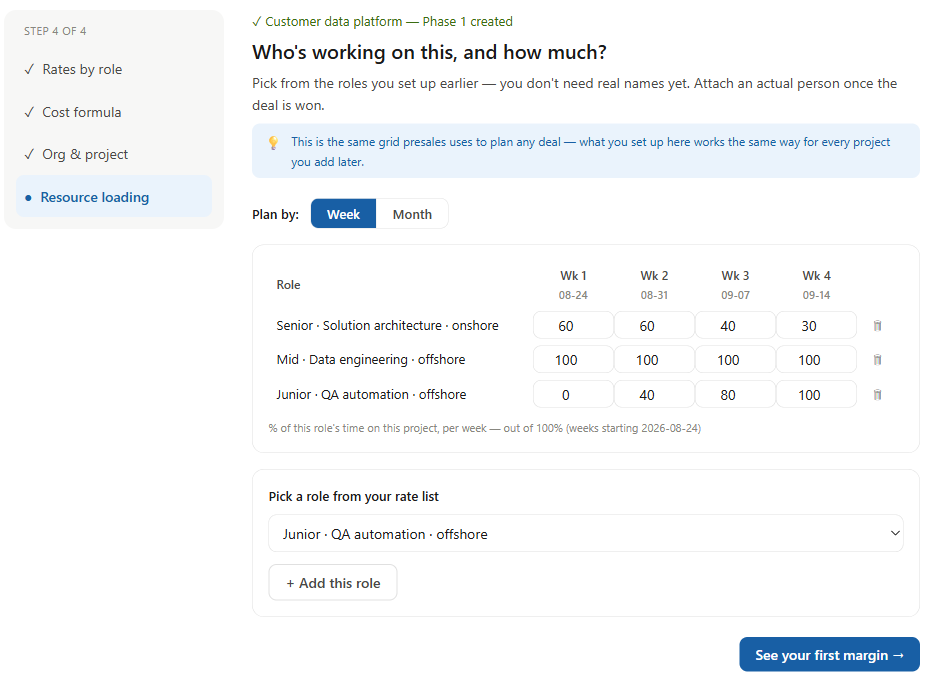
In Managed Margin, promotion is deliberately narrow. One pricing option can be promoted for a fixed-price purchase order. Promotion sets the approved budget and creates placeholder allocations from the selected team. It does not name every person, complete weekly planning, or activate the project. Those delivery-readiness steps still require human action. See pricing option to delivery baseline for the full checklist.
What should a pricing model not claim?
A scenario calculation is not predictive analytics. It cannot guarantee delivery performance, identify the best team automatically, or account for work that was never represented in the assumptions.
Managed Margin's current scenario preview uses the entered deal budget, pay-rate-derived labour cost, configured sales commission, and configured overhead. It does not use billing rates in that preview, although billing rates remain a distinct, relevant figure elsewhere in rate governance and time-and-materials work. It does not import timesheets or data from HR, payroll, CRM, ERP, invoicing, or accounting systems.
Use the product to make assumptions visible and calculations consistent. Keep expert review, scope control, client negotiation, and delivery decisions with the responsible people.
Sources and methodology
- UK Infrastructure and Projects Authority, Cost Estimating Guidance. Used for documented assumptions, exclusions, evidence, review, and sensitivity principles.
- Project Management Institute, PM101: Estimating. Used for the relationship among planned resources, duration, cost rates, and the project budget.
- UK Cabinet Office, Risk Allocation and Pricing Approaches. Used for fixed-price scope and supplier-risk principles.
- Product statements and formulas were reviewed against the current Managed Margin implementation on 24 August 2026. The worked example is original and educational.