A project margin rollup combines work by summing each included project's approved revenue basis and margin dollars, then dividing total margin by total revenue. Do not take a simple average of project percentages unless every project has the same revenue weight. Define status, currency, cost basis, and reporting period before aggregating, and keep pipeline work separate from committed delivery.
What is the margin-rollup formula?
Rollup margin = sum of included project margin dollars
Rollup revenue = sum of included project revenue bases
Rollup margin % = rollup margin / rollup revenue x 100
This ratio of sums is equivalent to weighting each project's percentage by its revenue basis. It prevents a small engagement from influencing the combined result as much as a project worth ten times more. The dollar totals also make the result easier to reconcile back to individual projects.
Worked example: why a simple average is wrong
Assume two included purchase orders use the same currency and cost policy. Purchase Order A has an approved budget of USD 100,000 and gross margin of USD 40,000. Purchase Order B has an approved budget of USD 25,000 and gross margin of USD 2,500.
| Item | Approved budget | Gross margin | Individual margin % |
|---|---|---|---|
| Purchase Order A | USD 100,000 | USD 40,000 | 40.00% |
| Purchase Order B | USD 25,000 | USD 2,500 | 10.00% |
| Rollup totals | USD 125,000 | USD 42,500 | 34.00% |
Correct: USD 42,500 / USD 125,000 x 100 = 34.00%
Incorrect simple average: (40.00% + 10.00%) / 2 = 25.00%
The simple average understates the combined result because it gives the USD 25,000 purchase order the same weight as the USD 100,000 purchase order. The correct 34.00% can be traced directly to total margin dollars and total approved budget.
A boundary case: a loss-making component in the same rollup
Extend the same two purchase orders with a third: an approved change-order Purchase Order C with a USD 20,000 budget that closed at a USD 4,000 loss, or -20%. The weighted formula does not change for a negative component.
| Item | Approved budget | Gross margin | Individual margin % |
|---|---|---|---|
| Purchase Order A | USD 100,000 | USD 40,000 | 40.00% |
| Purchase Order B | USD 25,000 | USD 2,500 | 10.00% |
| Purchase Order C | USD 20,000 | -USD 4,000 | -20.00% |
| Rollup totals | USD 145,000 | USD 38,500 | 26.55% |
The correct rollup is USD 38,500 / USD 145,000 = 26.55%. A simple average of the three percentages, (40.00% + 10.00% - 20.00%) / 3 = 10.00%, would understate the true weighted result by more than sixteen points here, and it would move in the opposite direction if the loss-making item carried the largest budget instead of the smallest. A rollup must include a loss on the same basis as a gain; excluding it or treating it as zero hides exactly the result a portfolio review exists to surface.
Which items belong in a project margin rollup?
Aggregation is only meaningful when the components share a compatible basis. The U.S. Government Accountability Office's cost guide emphasises a technical baseline, work breakdown, ground rules, assumptions, documentation, and updates with actual costs. A professional-services rollup needs the same clarity even when its calculation is simpler.
| Boundary | Decision | Reason |
|---|---|---|
| Status | Separate draft pipeline from active or committed work. | A scenario is not the same as an approved delivery obligation. |
| Currency | Use one reporting currency and a documented conversion policy. | Raw amounts in different currencies cannot be added meaningfully. |
| Margin layer | Aggregate gross with gross, or another consistently defined layer. | Mixing gross and after-shared-cost figures changes the numerator. |
| Time basis | Use planned figures together or actuals through one cut-off. | Different periods create false comparisons. |
| Archive rule | State whether archived projects are included. | The population affects both dollars and percentage. |
| Calculability | Identify records missing a valid revenue or cost basis. | Silently treating missing data as zero distorts the total. |
Portfolio walkthrough: aggregating three concurrent engagements
Consider a 35-person IT consultancy running three concurrent client engagements inside one delivery practice: a fixed-price enterprise-systems integration project for one client (an original SOW purchase order plus two approved change-order purchase orders), a monthly staff-augmentation contract for a second client, and a modernization proposal for a third client still sitting in Draft while contract terms are negotiated. At month-end, the practice lead wants one department-level rollup covering the whole portfolio. This is an illustrative scenario, not a customer result.
- Setting up the rollup: the Draft modernization proposal has no signed commitment yet, so including it would overstate the department's committed position. Apply the status boundary above and keep it in a separate pipeline view rather than the committed total.
- Mid-delivery, first client: the original SOW purchase order is joined by a second approved change-order purchase order, crossing the "meaningful at 2+ purchase orders" threshold described below. Before that point, treat the single-PO figure as directional rather than a stable project result.
- Currency mismatch: the staff-augmentation contract for the second client is invoiced from a different regional office in a different currency. Convert both engagements to one reporting currency under a documented policy, per the currency boundary, before summing anything.
- At the monthly review: a stakeholder asks for a quick blended percentage across the three clients and starts averaging the individual margin percentages. Point back to the weighted formula: sum margin dollars and revenue bases first, so the larger integration engagement isn't given the same weight as the smaller monthly contract. See choosing a project margin review cadence for how often to run this comparison.
- At project close: once the integration engagement finishes, decide explicitly whether its final margin stays in the ongoing department rollup or moves to an archived view, per the archive-rule boundary, so the live portfolio number doesn't quietly carry closed work indefinitely.
How do rollups work in Managed Margin?
The current product uses one calculation engine for purchase-order margins and builds higher views from those results. A project rollup sums every non-Draft sibling purchase order under the project. This lets an original purchase order and approved scope-change purchase orders remain individually visible while also showing the engagement total.
Client and department rollups sum the included projects' approved budgets and planned gross-margin dollars, then recalculate the percentage from those totals. Financial detail is permission-controlled. The portfolio view keeps Draft pipeline entries and non-Draft work in separate lists rather than creating one blended figure. See the full Managed Margin workflow for how these rollups sit alongside pricing and delivery.
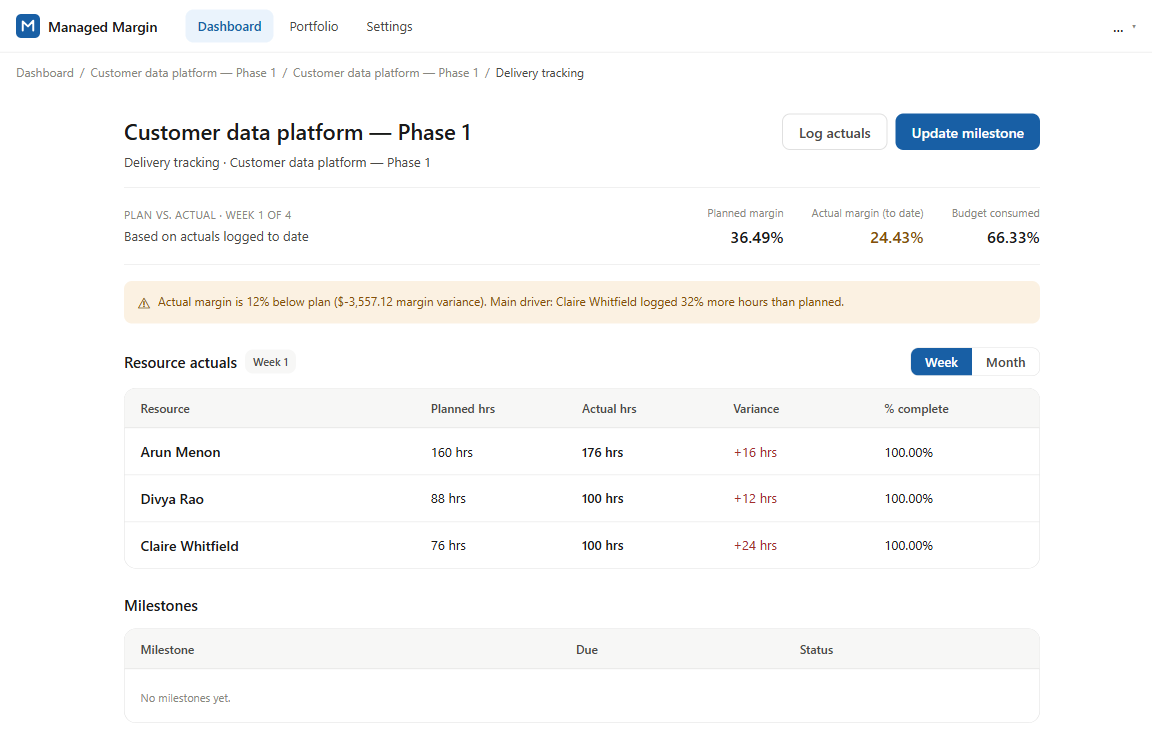
The implemented aggregate rollups use planned gross margin. They do not aggregate Managed Margin after shared costs, actual-to-date margin, operating margin, or net margin. A project rollup is marked meaningful once at least two non-Draft purchase orders exist.
Margin-rollup validation checklist
- List the exact projects or purchase orders included.
- Confirm status, archive, currency, period, and cost-basis rules.
- Exclude Draft scenarios from committed-work totals.
- Sum approved-budget dollars and margin dollars separately.
- Divide the summed margin by the summed approved budget.
- Reconcile totals to the underlying records.
- Flag missing or non-calculable items rather than treating them as zero.
- Keep the row-level breakdown available beside the aggregate.
- Label planned, actual, gross, and after-shared-cost views explicitly.
Start with the professional-services project margin guide for the full workflow. To understand the base numerator, read how to calculate project margin; for the product's shared-cost layer, see what Managed Margin means.
Sources and methodology
- U.S. Government Accountability Office, Cost Estimating and Assessment Guide. Used for baseline, ground-rule, documentation, work-breakdown, and actual-cost update principles.
- UK Infrastructure and Projects Authority, Cost Estimating Guidance. Used for consistent cost breakdowns, transparent assumptions, exclusions, and traceability.
- The weighted formula, Draft exclusion, rollup levels, permission boundary, and planned-gross-margin limitation were reviewed against the current Managed Margin implementation on 24 August 2026. Figures are illustrative.