A project rate card is a governed table of role-based cost and billing assumptions. Useful entries identify role or band, skill, location, cost rate, billing rate, currency, effective date, and owner. The card supports repeatable estimates only when definitions, access, approvals, versioning, and exceptions are documented.
What is a project rate card?
A project rate card gives estimators a controlled way to translate resource effort into cost or client-facing value. It is not merely a list of prices. The card should identify what each rate represents, the unit to which it applies, the date from which it is valid, and who is permitted to view or change it.
Two firms can use the same label and mean different things. A "cost rate" might include only direct compensation, or it might include employer on-costs, non-productive time, and allocated overhead. A "billing rate" might be a standard list rate, an agreed client rate, or a project-specific exception. The definition belongs beside the data or in a linked policy.
The UK government's service-costing guidance emphasizes transparency, consistent allocation, validation, and version control. Those principles are especially relevant when rate-card data passes from finance to presales and then delivery: the value must carry enough context to be interpreted consistently.
Which fields make a rate card useful?
| Field | Purpose | Control question |
|---|---|---|
| Role or band | Connects work to a repeatable capability level | Are adjacent levels distinct enough to price? |
| Skill or discipline | Distinguishes cost or price where specialisation matters | Is the tag defined and used consistently? |
| Location | Identifies the geography or delivery model behind the assumption | Does the label describe a governed category? |
| Cost rate | Converts planned or actual effort to internal labour cost | Which cost components are included? |
| Billing rate | Supports time-based pricing or a commercial reference | Is it list, client, or project specific? |
| Unit and currency | Prevents invalid arithmetic | Are hourly and daily values clearly separated? |
| Effective date | Preserves which assumption applied at approval | Will a new entry replace history or start a new period? |
| Owner and status | Identifies accountability and whether the entry is approved | Who validates and retires it? |
A compact card may not store every field in one table, but the information should be traceable. Avoid free-text variants that mean the same thing, such as "Sr Consultant," "Senior Consultant," and "SC," unless a governed mapping connects them.
Original example: a small role card
The rates below are fictional and demonstrate structure only. They are not market data or pricing recommendations.
| Role variant | Band | Skill | Location | Cost/hour | Billing/hour | Effective |
|---|---|---|---|---|---|---|
| Strategy Lead | Lead | Strategy | Onshore | $95 | $180 | 1 Jul 2026 |
| Implementation Consultant | Senior | Delivery | Onshore | $70 | $145 | 1 Jul 2026 |
| Data Analyst | Intermediate | Analytics | Offshore | $38 | $90 | 1 Jul 2026 |
If an estimate uses 40 hours from the lead, 160 from the consultant, and 240 from the analyst, direct labour cost is $24,120: (40 × $95) + (160 × $70) + (240 × $38). That result is only direct labour under the stated rates. Commission, overhead, contractors, travel, software, tax, contingency, and other included costs must be addressed according to policy. This rate-times-hours approach is a form of parametric estimating; see parametric estimating for services for how to build and validate the unit rates behind it.
A later rate change should normally create a new effective entry. Replacing the July values with October values would make the original estimate difficult to reproduce. When a client-specific billing rate is negotiated, record it as an exception or separate governed entry rather than silently changing the standard rate.
Rate-card governance checklist
- Publish written definitions for cost rate, billing rate, overhead, unit, and location.
- Assign an owner who approves additions, changes, exceptions, and retirement.
- Restrict sensitive cost-rate access to roles that require it.
- Use effective dates and retain enough history to reproduce approved estimates.
- Validate currency and unit before rates are used in calculations.
- Review duplicate or overlapping role variants.
- Document client-specific, project-specific, or manually overridden rates.
- Check that overhead is not included in the rate and then added again.
- Schedule periodic review, while allowing controlled updates when conditions change.
The Local Government Association's fee-calculator guidance illustrates that true staff cost can include salary, employer on-costs, non-productive time, and overhead, depending on the purpose and local model. HMRC's service-pricing guidance separately notes that service price can reflect factors beyond cost. Together, these sources reinforce why cost and billing fields need distinct definitions.
Keeping a rate card current through a cloud-migration project
Consider an illustrative case: a regional systems integrator runs a cloud-migration project blending onshore architects and offshore migration engineers across two countries, billed under one master services agreement. The rate card is what keeps pricing and delivery cost consistent across that mix.
- At kickoff, estimating the deal: sales quotes the project using an offshore migration-engineer cost rate that predates a recent compensation increase. Validate the applicable effective-dated entry before quoting, per the effective-date field above, instead of relying on a remembered number.
- Mid-delivery, a role substitution: the named offshore migration engineer leaves and is replaced by someone at a different band. Confirm the replacement maps to a governed role-and-band entry rather than typing in a one-off rate; the duplicate-and-overlap review item exists for exactly this kind of drift.
- At a scope change: the client asks for an onshore security specialist to support a compliance review, a role not currently on the card. Add it as a new governed entry with an owner's sign-off, per the governance checklist, rather than folding an ad hoc number into the estimate.
- At contract renewal: the client negotiates a lower billing rate for the offshore team in exchange for a longer term, while the internal cost rate must stay unchanged. Record the negotiated rate as a documented exception, keeping cost rate and billing rate distinct so overhead and margin calculations still use the correct figure.
- At the next scheduled review: it is tempting to update only the onshore rates because the offshore currency "hasn't moved much." Apply the periodic-review checklist item above to both regions together; a stale entry on either side quietly breaks the cost calculation for every future estimate that references it.
What does the Managed Margin rate card store?
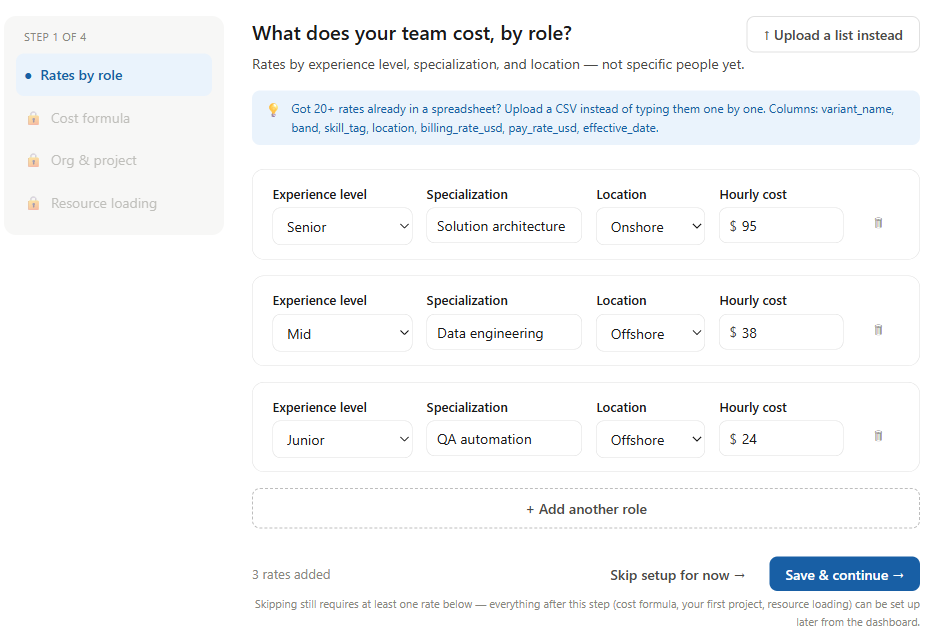
Managed Margin supports rate-card entries with a role variant name, band, skill tag, location, billing rate, pay rate, and effective date. Authorised finance or admin users maintain rates. Pay-rate values are hidden from users without the required access, while the workflow can expose the calculated margin percentage without exposing the underlying sensitive rate.
The current fixed-price scenario preview calculates labour from pay rates, not billing rates, then applies the deal budget, commission, and overhead. Effective dates help select the applicable entries. The product does not connect to payroll, HR, CRM, ERP, timesheets, invoicing, or accounting systems, so governance and maintenance remain the customer's responsibility.
For the conceptual distinction, read project cost rate vs billing rate. To apply the card, see resource-based project cost estimation or the Managed Margin pricing workflow.
Sources and methodology
- UK Government, Service Costing in Government. Used for transparency, consistent allocation, validation, and version-control principles.
- Local Government Association, Fee calculator guidance. Used for examples of cost components that can inform hourly staff cost.
- HM Revenue & Customs, Pricing of services. Used for the distinction between cost input and broader service-pricing factors.
- The sample card and calculation are original. Product claims were checked against the Managed Margin implementation on 24 August 2026.