Project cost rate represents the internal cost assigned to a resource hour; billing rate is the amount charged or valued for that hour under a commercial model. Their difference is not automatically project profit because commission, overhead, non-labour costs, discounts, fixed-price effort, and shared costs may also affect margin.
How are project cost rate and billing rate different?
A cost rate converts planned or actual resource time into an internal labour-cost amount. A firm may derive it from compensation and employer costs, use a standard role rate, or apply a fuller allocated-cost policy. There is no universally correct formula: the organisation must define which costs the rate includes and apply that definition consistently.
A billing rate is commercial. It converts billable time into client revenue when the contract is time based, or it can be used as a reference during pricing. HMRC's service-pricing guidance notes that price may be influenced by cost, the nature of the service, available alternatives, customer benefit, market conditions, and the parties' financial positions. Cost informs a price; it does not uniquely determine it.
| Question | Cost rate | Billing rate |
|---|---|---|
| What does it represent? | Internal cost assigned to resource time | Client charge or commercial value per unit of time |
| Typical owner | Finance or an authorised administrator | Commercial, finance, or pricing owner |
| Common use | Estimate and measure labour cost | Price time-based work or test a commercial position |
| Visibility | Usually restricted because it can reveal sensitive assumptions | May be visible to sales, clients, or delivery under policy |
For example, a firm might choose to include salary, employer on-costs, and an allowance for non-productive time in a cost rate. The Local Government Association's fee-calculator guidance describes those components as relevant when calculating a true hourly staff cost, while noting that local circumstances differ. Another firm might keep overhead outside the labour rate and apply it separately. Both can work if the boundary is explicit and double counting is prevented.
Worked example: two commercial models, the same consultant
Assume a consultant has a governed cost rate of $55 per hour and a standard billing rate of $120 per hour. These figures are illustrative, not market benchmarks.
| Measure | Time-and-materials example | Fixed-price example |
|---|---|---|
| Commercial basis | 100 billed hours at $120 | $18,000 agreed project price |
| Revenue | $12,000 | $18,000 |
| Planned labour | 100 hours at $55 = $5,500 | 100 hours at $55 = $5,500 |
| Amount before other included costs | $6,500 | $12,500 |
In the time-and-materials example, the $65 hourly spread produces $6,500 before commission, overhead, non-labour cost, write-offs, and other included items. It should not be labelled final project profit.
In the fixed-price example, the billing rate does not calculate contracted revenue: the $18,000 deal price does. If actual effort becomes 140 hours, labour cost rises to $7,700 and the amount before other included costs falls to $10,300, even though the standard billing rate never changed. This is why a fixed-price review needs approved effort and actual effort, not only a rate-card spread.
What should a rate policy make explicit?
- Define the unit. State whether the rate is hourly, daily, weekly, or another unit and how conversions are handled.
- Define included cost. Document whether employer costs, non-productive time, overhead, contractor cost, or other items are inside or outside the cost rate.
- Separate the two fields. A cost-rate change should not silently alter the client billing rate, or vice versa.
- Use effective dates. Preserve the assumption that supported an approved estimate instead of rewriting history.
- Control access. Limit sensitive internal rates while giving each role the information needed for its decision.
- Document exceptions. Record negotiated discounts (see how discounts affect project margin for the mechanics), project-specific rates, and manual overrides with an owner.
The UK government's service-costing guidance recommends transparent allocation methods, consistent application, validation, and version control. Those controls are useful beyond government: without them, two teams can call a number a "cost rate" while including different cost categories.
How this plays out on a managed-services contract renewal
Consider an IT managed-services provider renewing a client's annual support contract: a fixed monthly retainer plus an hourly rate for overage, staffed by a mix of senior and junior support engineers with different cost rates. The cost-rate/billing-rate distinction above matters at several points in that renewal cycle.
- At the renewal negotiation. Before agreeing to hold or lower the blended billing rate to win the renewal, confirm the true cost rate per engineer, including on-costs, as defined above. A lower billing rate against an unchanged cost basis quietly shrinks the spread that funds the desk, even though the deal looks like a win.
- When the new contract starts. If the renewed billing rate takes effect but an engineer's cost rate was not refreshed at the same time—for example, after a raise—the assumed spread is already wrong from day one. Apply effective dates to both fields, as the governance section above recommends, not just the client-facing one.
- Mid-contract, during a support escalation. A spike in overage hours that pulls in a senior engineer can raise labour cost for that period even while the flat retainer revenue looks unchanged. The same effect shown in the fixed-price worked example above—cost moving while the commercial figure stays flat—applies here too.
- When a client asks for a blended-rate report. Share the billing side freely, but keep the underlying cost rate restricted to the roles that need it for margin decisions, consistent with the access-control point above.
- At the next renewal review. Compare the spread the team actually realised over the contract year against the spread assumed at signing. A team that stayed fully utilised is not the same as a contract that held its margin—see why utilization and profitability can move in opposite directions.
How does Managed Margin use the two rates?
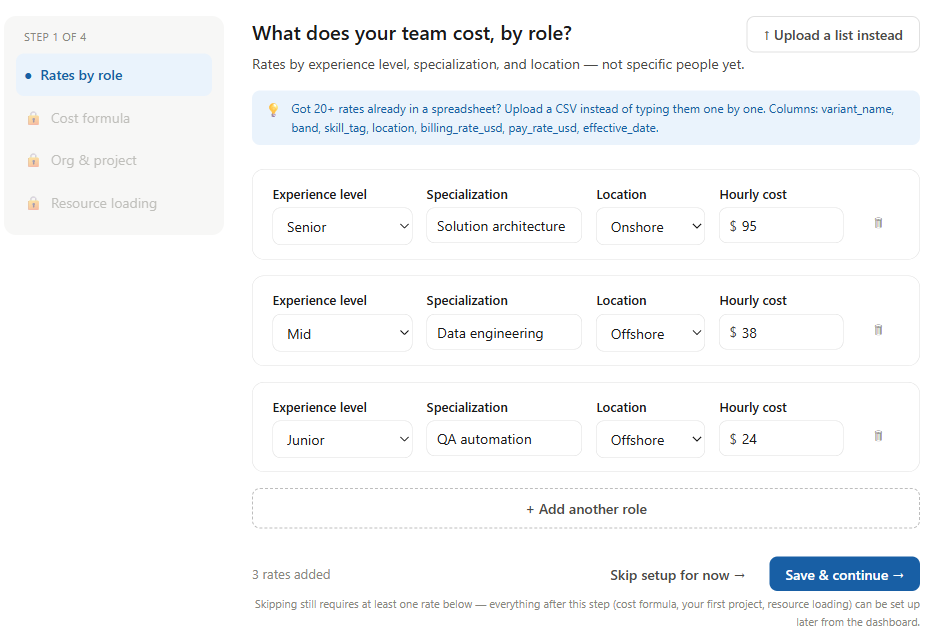
Managed Margin rate-card entries can identify a role variant, band, skill tag, location, billing rate, pay rate, and effective date. Pay-rate visibility is restricted for users without the required access; billing rates can remain available for their authorised workflow.
The current presales scenario preview uses deal budget, pay-rate-derived labour, commission, and overhead. It does not use billing rates in that formula. Scenario promotion is fixed-price only. During active delivery, authorised teams can record weekly actual hours against the plan and review current margin variance.
Managed Margin does not connect to payroll, timesheets, invoicing, accounting, CRM, HR, or ERP systems. A rate is only as reliable as its definition, effective date, access controls, and maintenance process. For the operating model, read the project rate-card guide. For the broader workflow, see project pricing for professional services.
Sources and methodology
- UK Government, Service Costing in Government. Used for transparent allocation, validation, consistency, and version-control principles.
- Local Government Association, Fee calculator guidance. Used for examples of components that can inform true hourly staff cost.
- HM Revenue & Customs, Pricing of services. Used for factors that can influence a service price.
- The worked example is original. Product claims were checked against the Managed Margin implementation on 24 August 2026.