Moving from ROM to fixed price means replacing assumptions with evidence and deciding who owns the remaining risk. Confirm scope and acceptance, estimate work packages and role hours, test the resource plan, add costs once and price to an approved margin. A smaller range alone does not make a fixed-price offer defensible.
Terms used in this guide. fee: the amount charged to the client; cost: the expense included in the stated project model; margin: revenue left after the included costs; margin percentage = that amount / revenue × 100; baseline: the approved original plan kept for comparison.
In plain words
Turning a ROM into a fixed price means replacing guesses with evidence: agreed scope, a task-level estimate, a checked resource plan and an approved margin. A narrower range alone is not enough. A fixed price asks the firm to carry the risk, so it must be earned.
Who this helps: Presales leads, project managers and finance staff who approve fixed-price offers.
Questions this guide answers:
- How do you turn a ROM into a fixed price?
- What evidence do you need before giving a fixed price?
- Can unresolved work be included in a fixed fee?
Read first: What is a ROM estimate? explains the basics and the lifecycle this guide builds on.
What is the calculation from a ROM range to a fixed price?
Fee = selected non-revenue-based cost / (1 − revenue charge share − target margin)
Margin at a negotiated fee = 1 − revenue charge share − selected cost / fee
Select the delivery scenario before using the formula. A lower offered fee changes margin even when the approved work stays identical.
What changes between an early ROM and a firm fixed-price offer?
| Stage | Evidence to add | Decision |
|---|---|---|
| ROM | Project type, reference project, key unknowns | Is the opportunity feasible? |
| Budget estimate (after discovery) | Access tests, backlog, scope boundaries | Which delivery scenarios remain? |
| Detailed estimate | Work packages, role hours, cost policy | Can the team deliver this scope? |
| Commercial review | Risk ownership, acceptance, fee and terms | Can the firm approve this commitment? |
| Delivery baseline | Approved version, resources, responsibilities | What will delivery measure against? |
What these gates are, and are not
- They are review gates, not industry classes, and no percentage range comes with a stage.
- A detailed estimate can still be uncertain if a critical dependency is open.
- A team that sells a repeatable service can sometimes be confident much earlier.
A ROM supports a feasibility decision. A fixed price is a commitment for a defined outcome. Moving from one to the other needs new evidence and a new owner for the risk, not a new document title or a narrower displayed range.
Gate each important driver separately
- Has the interface been tested?
- Has the buyer agreed the workflow?
- Are the roles available?
- Are acceptance and client inputs defined?
Keep the earliest estimate as history, and have later versions explain additions, removals and resolved uncertainty. That lets the client understand the final price and lets delivery tell the approved commitment from the assumptions used for the first budget talk.
Which evidence narrows an estimate enough for a fixed price?
Specific evidence removes specific unknowns: a tested integration, an approved workflow, a profiled data sample. A longer requirements document may remove none.
Keep an uncertainty log
| Question | Current assumption | Evidence received | Remaining exposure | Owner |
|---|---|---|---|---|
| Does the ERP API return stable IDs? | Yes | Sample calls succeeded for 200 records | Retry behavior untested | Engineering manager |
Update the affected work packages rather than trimming contingency to make the price easier to sell.
Scenario: the integration range narrows, the testing range does not
- The ROM had an integration package of 100–220 hours.
- After a successful API test and an agreed field mapping it narrows to 120–150.
- The testing package stays wide because acceptance criteria are still open, so the whole-project range narrows only partly.
- Discovery also removes the cheap case: the total range moves up as well as narrowing. The presales lead explains that, instead of forcing the final price back inside the original optimistic range.
Separate evidence from intention: “the client will supply data” is weaker than receiving and profiling an export, and “we plan to reuse the component” is weaker than confirming it works.
How do you turn the chosen estimate into a fixed price?
Suppose the selected labor and other non-revenue-based costs total USD 42,000, including coordination and risk treatment. Commission is 4% of revenue, allocated overhead 8% and the target managed margin 25%. That leaves 1 − 0.04 − 0.08 − 0.25 = 63% of the price to cover cost, so the target price is 42,000 ÷ 0.63 = USD 66,666.67 before any rounding policy. Check forwards: revenue-based charges are USD 8,000 and the remaining contribution is USD 16,666.67, which is 25%.
| Case | Cost | Price | Margin |
|---|---|---|---|
| Target | 42,000 | 66,666.67 | 25% |
| Sales negotiates down | 42,000 | 62,000 | about 20.3% (contribution 12,560 after 12% charges) |
| Difficult integration adds 6,000 | 48,000 | 66,666.67 | about 16% (contribution 10,666.67 after 8,000 charges) |
Present the approver with the fee and its resulting margin, not the original target as a claim. For the integration risk, decide whether to include it in the price, resolve it through discovery, or agree a change mechanism. Calling it “contingency” does not make it disappear.
Terms in this example. Non-revenue-based costs are costs that do not grow with the price, such as people and licenses. Revenue-based charges are a share of the price, such as commission. Here overhead is charged as a share of the price; in the ROM vs definitive example it was added as a percentage of labor cost. Use whichever convention your finance policy defines, and say which one you used.
What must be approved together with a fixed price?
- Deliverables, acceptance criteria and named client responsibilities.
- The resource plan, the role-rate basis and available delivery capacity.
- The cost boundary, how contingency is treated and what margin means.
- Dependencies, exclusions, commercial terms and the change approval process.
- The exact estimate version delivery will use as its baseline.
What happens after approval
- The project manager receives the assumptions delivery must manage, with the client agreement or purchase order.
- During delivery, actuals and remaining work are compared with the baseline.
- Approved changes carry their own record, so they never erase the original pricing decision or make every later cost increase look planned.
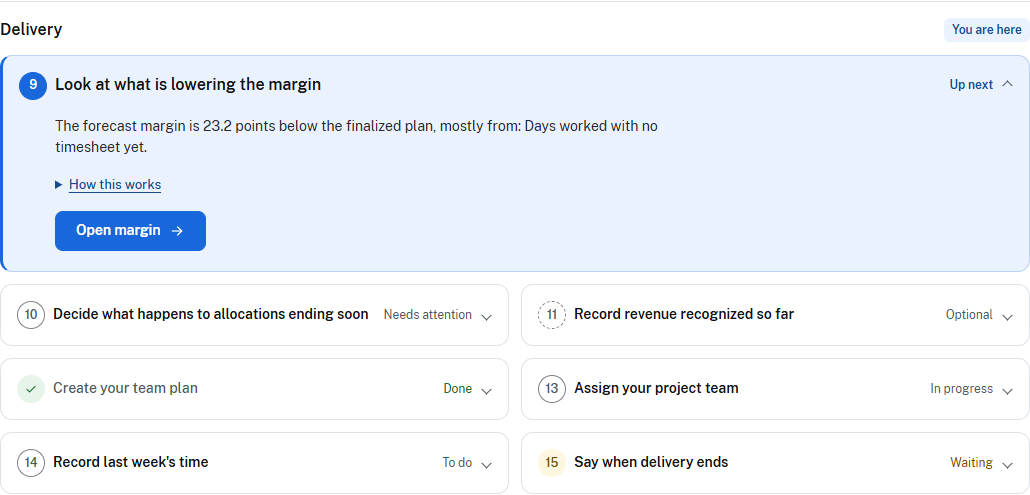
A frozen baseline records an approved plan; it does not promise the plan will be met. Managed Margin can link the chosen pricing strategy to the delivery baseline, and the assumptions and approval record explain what the numbers represent.
Can unresolved work be included in a fixed fee?
It can, when the firm deliberately prices and accepts that exposure. Some unknowns are better handled through a capped investigation, an allowance with defined rules or a separate phase. Choose the treatment with the responsible delivery and commercial owners, then state it consistently in the offer.
Real example: a presales lead decides she is not ready to fix a price
An illustrative story with invented figures, to show how the idea works in a real office.
Shreya, a presales lead, gave a ROM price range of USD 90,000 to 130,000. The client now wants a fixed price by Friday. She checks her list, phase by phase. Phase 1: scope written down, acceptance criteria agreed, task-level estimate done, plan checked by delivery. Phase 2: scope written down, but acceptance is not agreed, the estimate is only partly built and delivery has not checked it.
She tells the client: “We can fix the price for the first phase: the scope and acceptance criteria are agreed and our delivery lead has checked the plan. The second phase has an open question about the integration, so we propose a short paid discovery for it and will price it afterwards.”
The client accepts. A fixed price for everything would have been a bet; a fixed price for the part that has passed every gate is a price the firm can defend.
At which project stage can you safely fix a price?
Fixing a price is a stage gate, not a calculation. The numbers are the easy part; the gate asks whether the uncertainty has been reduced enough for the firm to carry the remaining risk. A presales lead walks a new teammate through it in this order.
| Gate | Who decides | Checkpoint |
|---|---|---|
| ROM to budget estimate | Presales lead | Scope is written; the biggest unknown has an owner and a date |
| Budget to detailed estimate | Delivery lead and presales consultant | Every hour sits on a task, with roles, rates and assumptions |
| Detailed estimate to price | Presales lead and finance; the deal desk if there is a discount or the margin is below policy | Cost ÷ (1 − target margin) is met, risk is priced or excluded, and the review was not done by the author |
| Price to contract | Sales, legal and the client | Acceptance criteria, change process and exclusions are signed together with the price |
| Contract to delivery | Project manager | The estimate becomes the baseline the project is tracked against |
If a gate is not passed, you do not fix the price: you offer a paid discovery, a capped time-and-materials phase or a smaller first phase instead.
ROM to fixed price: frequently asked questions
Do all unknowns have to be resolved before a fixed fee?
No, but the remaining exposure must be deliberately assessed, priced or allocated through the agreed terms. Some unknowns are better isolated in another phase. The approver needs to understand the commitment rather than infer certainty from a narrow range.
Is the midpoint of the ROM the fixed price?
A midpoint is an arithmetic summary of endpoints. It does not establish scope, staffing or risk treatment. Calculate the fixed fee from the selected delivery plan, relevant costs and commercial margin policy.
How do you carry the approved price into delivery in Managed Margin?
Keep exploratory alternatives as drafts while evidence develops. For the selected fixed-price case, reconcile USD 42,000 non-revenue-based cost, 4% commission and 8% revenue-based overhead. An estimation strategy at 25% target produces approximately USD 66,666.67 under those linear cost assumptions.
If the buyer offers USD 62,000, use a quoted-price strategy to show its approximately 20.26% margin instead of assuming the target still holds. Compare the difficult effort plan separately. Finalize the accepted strategy so its roles, rates and costs become the approved baseline. Handover then requires the commercial evidence and project-manager ownership supported by the current workflow, before delivery accepts the plan.
Explore the pricing and estimation workflow or review the delivery margin workflow.
Background reading: ROM vs Definitive Estimate and protecting margin on a fixed-price project.
- Assumptions and Exclusions in an Estimate: 40 IT Examples
- How Much Contingency to Add to a Project Estimate
Continue the sequence: guides to read next
- ROM Cost Estimate Examples for IT Projects: five worked ROM calculations for services projects
- ROM vs Quote vs Definitive Estimate: What Differs?: how an early range differs from a definitive estimate
- How to Manage Fixed-Fee Project Margins in Consulting: protecting margin once the price is fixed
- Project Baseline Handoff: From Sales to Delivery: freezing the estimate as the delivery baseline
Sources and methodology
Outside facts in this guide, and where they come from
- US FAR 16.202-1, firm-fixed-price contracts: a firm-fixed-price contract places full responsibility for cost, and the resulting profit or loss, on the supplier
The examples, templates and calculations are original editorial illustrations, not market benchmarks or customer results. Monetary amounts are in USD, exclude tax unless stated, and use the cost boundaries defined in the article. Validate assumptions against your own delivery history before quoting.
Further background: GAO cost-estimating process. The worked arithmetic and scenarios above are original; this reference provides context and is not a source for market rates or the stated example amounts.
The application walkthrough was checked against the current stage, pricing, cost-rule and delivery calculation code on 13 October 2026. Forecasts describe recorded actuals plus the remaining plan, not predicted customer outcomes.