Add up the costs that do not depend on the price: labor, costs charged on labor and fixed costs. Divide by one minus your target margin and minus the costs charged as a share of revenue, such as commission or an overhead share. The result is the lowest price that still leaves your target after those costs: a project measure, not the firm’s net profit.
Terms used in this guide. fee: the amount charged to the client; cost: the expense included in the stated project model; margin: revenue left after the included costs; margin percentage = that amount / revenue × 100; baseline: the approved original plan kept for comparison.
In plain words
To price to a target margin you start from what the work costs and work backwards to the price that leaves the margin you want. The shortcut “add 30% to cost” gives a margin of only about 23%. The right formula is price = cost divided by (1 minus the margin you want), where the cost does not depend on the price. If commission or an overhead share is charged as a percentage of the price, subtract that share as well: price = cost ÷ (1 − share − margin).
Who this helps: Presales consultants, sales managers and finance staff who set or check prices.
Questions this guide answers:
- How do you price a project to a target margin?
- What is the formula for pricing at a given margin?
- What is the difference between markup and margin?
What is the formula to price a project to a target margin?
Price = costs not tied to revenue / (1 - revenue-based cost % - target margin %)
Costs not tied to revenue = labor + costs charged on labor + fixed costs
Margin is a share of revenue, so costs that are themselves a share of revenue grow with the price. That is why they sit in the bottom of the formula with the target, not in the cost total. Set the target on the margin after all included modeled costs (in Managed Margin this is the managed margin), or a price that looks profitable can lose money once overhead is charged.
Try the free managed margin calculator
Enter your costs, commission and overhead, and the managed margin calculator shows the price that earns your target margin, the gross, contribution and managed margin side by side, and what a discount does to them. Your figures stay in your browser.
How do you get the inputs right before using the formula?
The formula is only as good as what goes into it. A presales lead would walk a new teammate through four steps before anyone divides by anything.
- Start with the work, not the fee. Define the deliverables and acceptance, then estimate effort by role. In the example below, 200 analyst hours and 325 developer hours must come from that scope. (An analyst at 100% for five 40-hour weeks gives 200 hours.)
- Multiply hours by approved planning rates. Use the rate card, not last year’s quote.
- Check the cost rules one by one. Project management at 10% of labor and contingency at 5% of labor are labor-based rules. If project-manager hours are already in the role plan, the 10% rule would count them twice.
- Group charges by what they depend on. A fixed USD 500 license belongs to this scope. Commission and overhead are shares of the price and grow when the price grows, so they go in the divisor, not in the cost total.
Scenario: Jess runs the four-step check
Jess, a presales consultant, has a draft price. Before sending it to the lead she checks each step: the hours trace to a scope note, the rates are from the current card, the PM rule does not repeat the PM role, and commission is in the divisor. She finds the 10% PM rule duplicated a PM role already planned, removes it, and the price drops by about USD 3,500. The lead approves the corrected number without a second round.
The 5% contingency in the example is an assumption for these numbers, not a recommendation.
Target margin pricing example for an IT project
A fixed-price project needs a business analyst for 200 hours at a USD 35 cost rate and a developer for 325 hours at USD 40. The firm adds project management at 10% of labor, contingency at 5% of labor and USD 500 of software. Sales commission is 3% of revenue and the overhead share is 10% of revenue. The target is 30%. All figures are illustrative.
| Step | Calculation | Amount |
|---|---|---|
| Labor | 200 h x 35 + 325 h x 40 | USD 20,000.00 |
| Costs not tied to revenue | 20,000 + 2,000 + 1,000 + 500 | USD 23,500.00 |
| Divisor | 1 - 0.03 - 0.10 - 0.30 | 0.57 |
| Price | 23,500 / 0.57, rounded up to the cent | USD 41,228.08 |
| Revenue-based costs | 13% x 41,228.08 | USD 5,359.65 |
| Margin after all included modeled costs | 41,228.08 - 23,500 - 5,359.65 | USD 12,368.43 (30.00%) |
Check the result by working forwards, as in the last two rows: the price leaves exactly the target once all included modeled costs are taken off. For positive non-revenue-based costs, if revenue charges and the target total 100% or more, no positive finite price can reach that target; lower the target or the costs.
Margin vs markup: why adding 30% to cost is wrong
Adding 30% to cost is a markup, not a margin. Here, 23,500 x 1.30 = USD 30,550. Commission and overhead then take 13% of that price, USD 3,971.50, which leaves USD 3,078.50, only 10.08% of revenue. The gap comes from mixing a markup on cost with costs charged on revenue. See how to calculate project margin for the difference between margin and markup.
What hourly rates does time and materials need to hit a margin?
If the same work is sold as time and materials, each billable role needs a minimum hourly rate that brings in the same price for its planned hours. One proportional allocation, assuming every planned role hour bills, is the role’s cost rate × price / labor: here 35 x 41,228.08 / 20,000 = USD 72.15 an hour for the analyst and 40 x 41,228.08 / 20,000 = USD 82.46 for the developer, rounded up. This allocation recovers the modeled fee for the planned mix. It is not a unique minimum for each role: a higher rate on one role can offset a lower rate on another. Recalculate if hours, billability or the role mix change.
How does a price range affect margin?
A rough order of magnitude estimate should explain uncertain scope or effort. The calculation here instead isolates price sensitivity: move the fee, keep modeled effort unchanged, and show the margin at each end. At 10% below (USD 37,105.27) the margin falls to 23.67%; at 20% above (USD 49,473.70) it rises to 39.50%. The range changes the price, not the work, so it illustrates negotiation sensitivity rather than delivery uncertainty. Separately test effort risk: if non-revenue-based cost rises from USD 23,500 to USD 28,500 at the target fee of USD 41,228.08, margin after 13% revenue charges falls to about 17.87%. A price range does not cover that extra work automatically.
What decision does a target-margin price support?
Suppose the buyer offers USD 38,000 for the same scope. Revenue-based costs are 13% × 38,000 = USD 4,940. Contribution after the USD 23,500 other costs is USD 9,560, so Managed Margin is about 25.16%. The target fee and the offered fee now answer different questions: what price meets 30%, and what margin does the buyer’s price leave?
In Managed Margin, keep an estimation strategy with Target Margin selected for the first question and a quoted-price alternative for the second. Retain the same work and cost rules so the comparison isolates price. If sales proposes less scope, revise the affected stage loading as another alternative rather than label a discount as reduced effort.
For T&M, the example’s minimum rates are one proportional distribution of the required fee across billable role hours. They require the assumed hour mix and billability to remain valid. A role that cannot be charged still costs money, and a changed staffing mix can require a different rate comparison. Recalculate before promising one permanent blended rate.
Before finalization, review scope, rate completeness, staffing feasibility and the difficult cost case. Finalize the accepted strategy as the baseline used for handover and delivery. The formula establishes economics under stated assumptions; it does not validate an untested integration or approve a commercial exception.
How do you price to a target margin in Managed Margin?
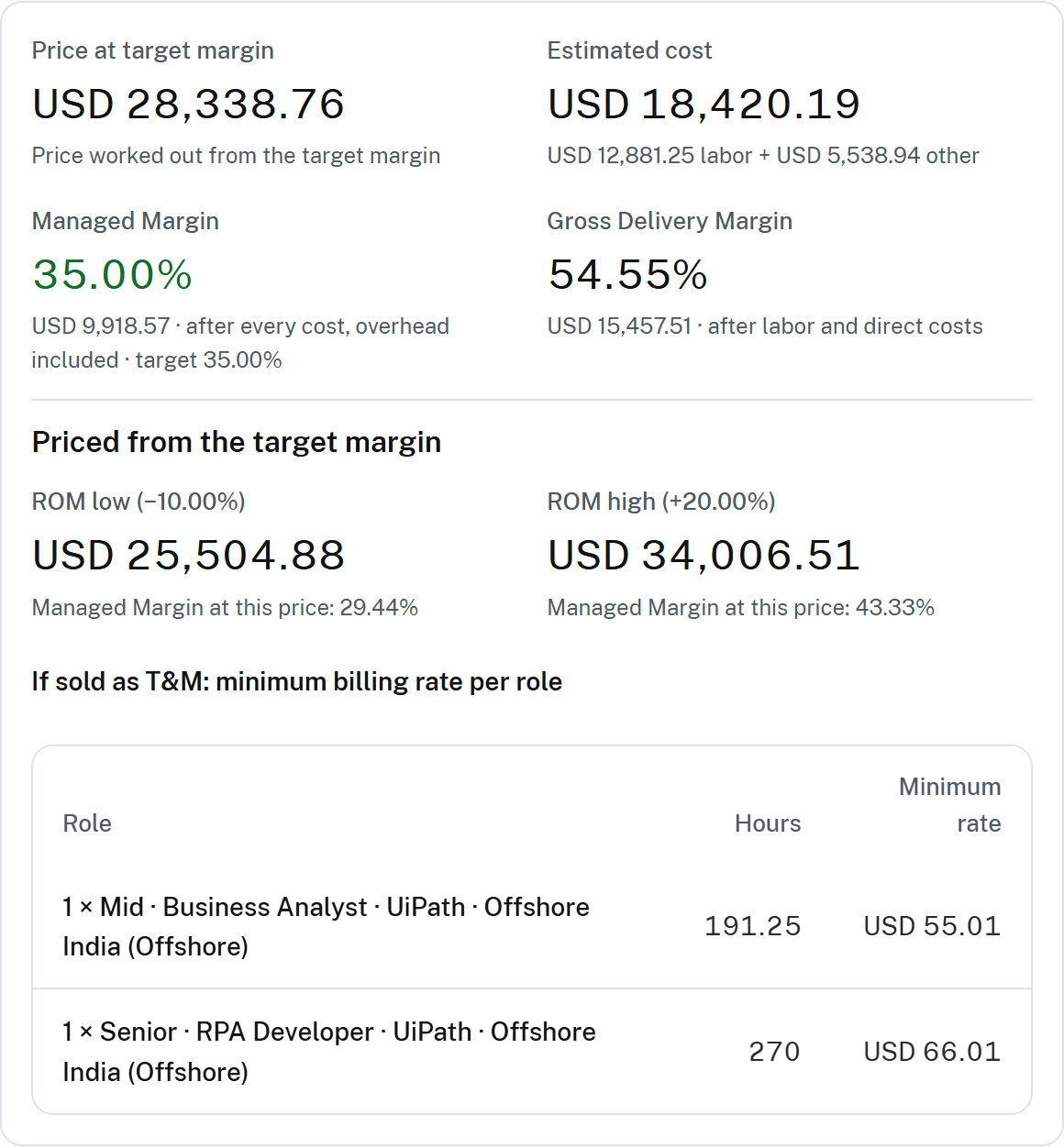
An estimation strategy plans the work stage by stage, with each role's loading per stage, and costs it at your planning rates and cost rules. It then works out the fixed price for the service order's target Managed Margin, the T&M rate each role would need to reach that price if every planned hour is billed and, if you want one, a ROM range with the margin at each end. Already have a price? A pricing strategy shows the margin it leaves instead. See project pricing software.
- How a Discount Affects Project Margin: Formula and Example
- How to Present a ROM Estimate to a Client Without Anchoring
- Project Margin Management: What It Is and How to Do It
- Cost Rate vs Billing Rate: Costing and Rates Explained
- Project Estimation: Process, Methods and What to Consider
- ROM Cost Estimate Examples for IT Projects
Real example: a presales consultant fixes a markup mistake
An illustrative story with invented figures, to show how the idea works in a real office.
Jess, a presales consultant, has a project whose direct cost is USD 70,000 (no commission or overhead share in this simple case). Her manager says, “Add 30% and we are fine.” Adding 30% gives USD 91,000. The margin on that is (91,000 minus 70,000) divided by 91,000, which is 23%.
The firm’s target is a 30% margin. The formula is price = cost divided by (1 minus 0.30) = 70,000 / 0.7 = USD 100,000, and the margin on that is exactly 30%.
She shows both numbers side by side. The USD 9,000 difference is the price of confusing markup with margin.
When do you price to a target margin, and what comes before and after?
| Stage | Owner | Checkpoint |
|---|---|---|
| Scope and estimate | Presales consultant with a delivery lead | Hours trace to deliverables; rates are from the current card |
| Choose the target | Finance or leadership | The target is the margin after all included costs (managed margin), not gross margin |
| Calculate the price | Presales consultant | Costs not tied to the price are separated from shares of revenue; result is checked by working forwards |
| Review | Presales lead and finance | Difficult-case margin and the buyer’s offered price are both shown |
| Finalize | Final approver | The accepted strategy becomes the baseline for handover |
Pricing to a target margin: frequently asked questions
What hourly rates does time and materials need?
Rates that, over the expected hours, deliver the target margin after non-labor costs. Work backwards from the blended rate.
How does a price range affect margin?
Each end of the range has its own margin. Check both against policy before sending the range.
How do you price a project to a target margin?
Add up the costs that do not depend on the price, then divide by one minus the target margin minus any cost that is a share of the price (such as commission). For example, USD 23,500 of cost with 3% commission, 10% overhead and a 30% target gives 23,500 ÷ 0.57 = USD 41,228.08. Adding 30% to cost would give only about a 10% margin here.
Continue the sequence: guides to read next
- What Is Managed Margin? Meaning, Formula and Software: what managed margin means and how it differs from gross margin
- How to Price an IT or Professional Services Project: how professional-services firms set project prices
- How to Calculate Project Margin (Formula + Example): the margin the price should deliver
Sources and methodology
- UK Infrastructure and Projects Authority, Cost Estimating Guidance. Used for keeping cost assumptions, contingency and exclusions explicit.
- The formula is arithmetic on the definitions above. The example is synthetic. Amounts are in USD and exclude tax. The calculation was checked against the current Managed Margin application on 12 October 2026; it is not a market benchmark or customer result.